
If you want to win your grievance, you need to know what argument to use and how to support your claim.
To be a good steward you need to be part detective and part lawyer. When you first learn of the grievance, you act like a detective. You question witnesses and gather evidence to make sure there is a grievance.
Then comes a crucial decision. You need to decide exactly what claim you are going to make and how you will argue your case. To make the right decision, you have to know something about putting together an effective formal argument.
Usually when we talk about arguments, we are talking about those noisy discussions in which both sides get angry and nothing ever gets resolved. But when we talk about arguing your grievance, we are using the term as an attorney or arbitrator would. We are talking about a formal argument, not a disagreement.
Not every grievance goes to arbitration, but you should always prepare your argument as though it will be heard by an arbitrator. First, a well-prepared argument is more likely to convince management that your case is strong. Second, you never know which cases will end up in arbitration, so you should always be prepared.
What is a formal argument?
A formal argument is a course of reasoning aimed at demonstrating truth or falsehood.
In preparing an argument for your grievance, you will do well to remember this definition. Note that the argument will be a "course of reasoning."
That means your argument will be based on logic, not emotion. It will be organized. And it will have a specific goal or target.
To be logical, your argument will rely on facts or statements put forth as evidence. That is why it is important to follow good investigative procedure when you collect facts.
Collect all the facts you can. You may not use them all, but the more you have, the more choices you have for creating a strong argument.
Likewise, do not ignore facts that don't support your position. The other side may use those facts in their case. You must be ready to rebut them.
The burden of proof
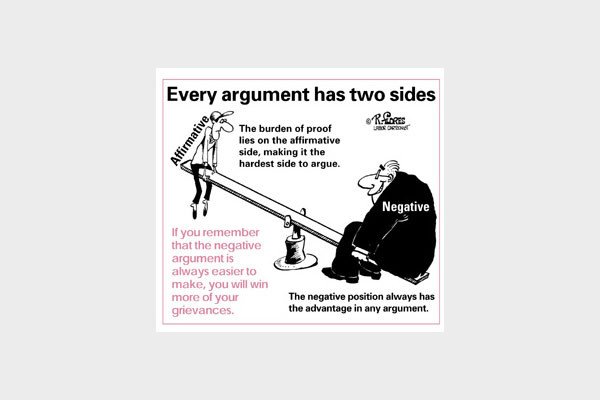
There are two sides to every argument: affirmative and negative. The affirmative position is the side which makes the "claim." The negative position is one of rebuttal, refuting the claims or evidence of the affirmative. The burden of proof always rests with the affirmative position.
The negative position always has the advantage in any argument. Making a claim and proving it is difficult; refuting the claim or some portion of the claim is far easier. For example, when a prosecutor claims that a criminal has committed a crime, he must show that the person was in a specific location at a specific time AND that he took some specific actions that were illegal.
The defense doesn't need to prove where their client was or what he was doing at the time the crime occurred. They just have to show that he wasn't at that specific location OR that he wasn't taking those specific actions.
Arguing a Grievance -- Example One
EXAMPLE 1: The company has given Joe Average a disciplinary step for missing work. The company says that Joe has in fact missed more than the allowable time, but since everyone knows he has been going through a divorce, they have been easy on him. Now they feel that Joe has had enough time to get his affairs in order, and they believe that the step is a "wake up call" for Joe. Joe goes to his union steward to file a grievance to get the step removed.
Is the company taking the affirmative or negative position?
The company is taking the affirmative position. They have made a claim against Joe Average. Therefore the company has the affirmative argument and the burden of proof.
What do they need to prove? If you look carefully, you see that the company has made three distinct claims:
- Joe has missed work
- Joe missed "more than the allowable time"
- The company has been easy on Joe -- they have let him exceed the standard limits for attendance.
Knowing that a negative argument is the easiest to formulate, you tell the company you will rebut their claims. The company has the burden of proof. You simply need to show that what they are claiming is not accurate.
To win the first claim, the company must show that Joe missed work. So you will need to determine what his attendance record has been. The company will have attendance records. You need to examine them. You can't just take Joe's word for it, because the company will be able to show those records as evidence. If he "forgets" a few of his absences, the company can use the official record to make it look like you haven't prepared your case well.
Once you have the actual record of his attendance, you can look into the second claim: that he has missed more than the allowable time. How much time is allowed? Is there an official attendance policy? Is there specific contract language about attendance? Is there a work rule that stipulates what is an excused absence and what is not? How have Joe's absences been counted, and is this method in keeping with the official method? If your research shows Joe is under the set limit, you can easily refute the company's argument. And if the company has never set a specific limit, you win by showing that fact. You cannot get a speeding ticket when there is no speeding limit.
Finally, the company has claimed that they have been giving Joe a break. To refute this, you need to look beyond Joe's record. It might be necessary to request the attendance records of all employees who are similarly situated. If you find that all employees get a disciplinary step when they reach the number of absences Joe has reached, then the company isn't giving him a break, they're just enforcing the rule. And if other workers have missed more work than Joe without getting a disciplinary step, then clearly they are not giving Joe a break. They may even be treating him more severely than others. In either of these cases, the mention of their easy stance on Joe has no merit, and should not become a permanent part of his file, regardless of whether they prove the other two parts of their claim. Such a statement may prejudice the handling of any grievances Joe files later.
Arguing a Grievance -- Example Two
EXAMPLE 2: Jane North has been a shop steward for about two years and has always been active in union affairs. She has never gotten along well with Bill Boss, the shift foreman, and in the last three months, she has filed an especially large number of grievances against him. She has also been seen in the last few months drinking heavily in a local bar on weekends. On Monday morning, Bill sends Jane home on a crisis suspension. He alleges that she had alcohol on her breath, slurred speech, and bloodshot, red eyes. Jane's best friend and fellow steward, Sarah South, files a grievance stating that Bill is simply trying to retaliate against Jane for her recent activity as a union steward.
What kind of argument is this, and how will they prove it?
The union has taken an affirmative position. They are claiming the foreman suspended Jane for her union activity. That is a very unfortunate decision on Sarah's part.
How can she prove that Bill suspended Jane for her union activity? He claimed he did it because she was drinking. Since no one can read his mind, we really don't know what he was thinking. Proving that the company has ill will, what lawyers call animus, toward a person or toward the union is very difficult. Unless Bill Boss told someone that he suspended Jane in retaliation for her union work, or announced ahead of time that he was planning to do so, then Sarah has no evidence to support her claim.
Sarah should have taken the negative argument. Instead of accusing Bill of retaliation, she should have simply demanded that he prove Jane was drunk on the job. Then the burden of proof would have fallen on Bill.
How could Bill have proven Jane was drunk? He did not give her a Breathalyzer test. He didn't refer her to a substance abuse counselor. No one else smelled alcohol on her breath. No one else said her speech was slurred. No one else said her eyes were bloodshot. Does the company have a policy about handling people who are drunk on the job? If so, did Bill follow it? If not, how has this problem been handled in the past? As you can see, Bill has a difficult case to prove -- one he'll probably lose.
Stewards are often tempted to try to make an affirmative argument when faced with a grievance. If you remember that the negative argument is always easier to make, you will win more of your grievances.
In the next issue of the Reporter, we will look at the best ways to present your evidence.